Submitted By Guri, PNG
Summary information
COMMON NAME OF EMERGENCY (e.g., frequently used name) Tropical Cyclone Guba
DATE (external/internal break-out) 17 November 2007
DURATION Ongoing, though immediate effects of cyclone have subsided. Rivers have broken banks damaging riverbank villages.
COUNTRY Papua New Guinea
SCALE (City/Regional/Country/Cross Country)
MAIN CLASSIFICATION (Natural Disaster, Conflict, Health/Medical, Incident, Other) PROVINCES: Northern Province (Oro) and Milne Bay Province
URBAN CENTRES AFFECTED (as estimated at this stage): Popondetta, Oro Bay, Collingwood Bay, Milne Bay
POTENTIAL AFFECTED AREAS: Northern coastline extending from Popondetta / Oro Bay in the North West to Milne Bay (nr Alotau) in the South East
CLASSIFICATION: Natural Disaster
ESTIMATED NUMBER OF PEOPLE AFFECTED 164 deaths confirmed as at 29/11/07.
Estimated between 20,000 and 30,000 people displaced.
DURATION OF RESPONSE 6-9 months
Tuesday, December 04, 2007

Thursday, June 07, 2007
Choiseul and Western Province Earthquake-Tsunami Situation Up-date
National Disaster Management Office
Western and Choiseul Province Earthquake & Tsunami Report #41
17May2007
SITUATION
1. An earthquake measuring 8.1 struck 345km northwest of the Solomon Islands' capital Honiara at 0740 local time on 2 April 2007. (2040 GMT 1 April). The earthquake created a tsunami causing significant damage in the Solomon Islands.
2. The NDC reports that the affected area includes Gizo, Simbo, Ranogga, Shortlands, Munda, Noro, Vella la Vella, Kolombangarra and parts of the southern coast of Choiseul. The worst-affected areas are the southern coast of Gizo, Simbo Island, Ranongga and the central southern coast of Choiseul between Moli and Posarae and Sasamunga.
3. 52 people have been confirmed dead.
4. Aftershocks are reported to have decreased.
5. Minister of Home Affairs Bernard Ghiro has revoked the order he made on 3rd April declaring certain areas in the Western and Choiseul Provinces to be in a state of disaster on the 5th of May.
NATIONAL RESPONSE
6. An NDMO officer is continuing to operate the airport reception centre to receive, register and guide incoming relief teams.
7. Medical and Civil Aviation Action Desks in the NDC head office are still working.
8. 98 per cent of the data brought over from Gizo has been completed.
9. Shortlands Islands data brought over Monday this week is almost completed.
10. NDMO Director Loti Yates will leave the country on Monday to attend the inaugural Melanesian Volcanologists Network and return on Sunday 27th May.
REGIONAL RESPONSE
11. The Ministry of Health has sent in the following update of 16th May:
Facilities that need rebuilding Replacing or major repair(s) needed Already dilapidated, further damaged by earthquake/tsunami
Gizo TB ward Vonunu AHC Harapa RHC
Sasamungga Ughele AHC
Lale RHC Pienuna RHC
Boro RHC Iriqila RHC
Toumoa RHC Vanga RHC
Mondo NAP Falamae RHC
Kara NAP Voza RHC
Lambu Lambu NAP Maravari NAP
Rarumana NAP Karaka NAP
Viru NAP
Housing for more than 60 staff in Gizo and 16 staff at PHC clinics in Western Province and Choiseul has been damaged or destroyed. Staff housing is being assessed as part of the current survey.
Full infrastructure tours are currently underway and all 56 clinics will have been visited by the end of next week. The assessment report will be submitted on the 25th May. The MoH is continuing to provide health services in most of these locations. Efforts up to date have been to keep these services running. Temporary clinics with radios, water, toilets, drugs and equipment are being set up in places where there is no suitable shelter for a clinic. To date five of these temporary clinics have set up and another seven are in the process of being set up.
IN-COUNTRY RESPONSE
12. The 7-person ADB recovery team led by Rhisi has left Honiara yesterday to visit and re-assess affected communities for the recovery phase.
13. The Solomon Islands Bar Association (SIBA) handed over a cheque for SBD72,500 – contributions from local and overseas lawyers such as Canada, Hong Kong, UK, Australia and New Zealand. SIBA Tsunami Relief Fund Sub-committee chairman Andrew Radclyffe said they are also expecting another contribution from Malaysian lawyers and will hand that over once it arrives. Radclyffe said the money is being given specifically for support with water tanks for affected communities. NDMO Loti Yates who received the cheque thanked SIBA and asked the two representatives, Radclyffe and Ranjit Hewagama to pass NDC’s appreciation and assured that the money would go for its intended purpose.
14. Members of the Public Solicitors Office also handed over SBD10,000 cash to NDMO deputy Director Janet Batee. Miss Batee thanked the staff and assured them the assistance will get to the people for whom the money was intended.
15. A Central Islands Disaster Committee team also handed in SBD38,000 with goods in kind. The donation has been possible after several fundraising activities the committee has carried out in the past month up to now. Them donations were handed over by George Pego the vice Chairman of the Fundraising committee to NDMO Director Loti Yates.
IN-COUNTRY INTERNATIONAL RESPONSE
16. The PNG Defence Kumul 21 has officially terminated its assistance in Disaster Relief Operations. The NDMO Operations and airport logistical support desk officer says the plane will fly back to PNG at 0500am tomorrow via Munda for a technical stop.
17. UNICEF says it has dispatched educational equipment – 2nd batch of 40 – 50 boxes; 21 packages of tarpaulins; 1 box of fax/photocopier/printer and 11 boxes of volunteer kits on the Kumul 21 flight on Wednesday 16th May.
17: Road To Recovery
Terminology: the National Disaster Plan outlines 3 phases (see page 2). In order to adjust to the current requirements, it is suggested to adopt the following terminology in this paper:
Early recovery: Also relates to “Recovery phase” in the National Disaster Plan. Early Recovery is recovery that begins early in a humanitarian setting. This phase is expected to last between 1 to 4 months. It is a multi-dimensional process, guided by development principles. It aims to generate self-sustaining, nationally-owned, and resilient processes for post-crisis recovery.
Recovery: Also referred as Rehabilitation and Reconstruction phase in the National Disaster Plan. This phase for this disaster is expected to last up to 2 years. A recovery approach focuses on how best to restore the capacity of the government and communities to rebuild and recover from crisis and to prevent relapses. In so doing, recovery seeks not only to catalyze sustainable development activities but also to build upon earlier humanitarian programmes to ensure that their inputs become assets for development.
Effective and consistent coordination of stakeholders is paramount for the success of the recovery. Priority should be given to enhancing the coordination capacities at National and Provincial levels with appropriate and dedicated full time staffs.
18. The early recovery operation will aim to:
• Ensure smooth transition with the phasing out of the emergency operations
• Promote spontaneous recovery initiatives by the affected population and mitigate the rebuilding of risk
• Establish the foundations for longer term recovery.
• Integrate risk reduction measures into recovery and development.
19. TAT endorses the priorities NDMO has identified for the transitional phase from relief to long term recovery and complements these as follows (the sectors below are not listed in order or priority but reflect all the needs to be covered during the early recovery phase):
Housing and shelter Water supply and sanitation
IDPs Management Coordination and Information Management Livelihood recovery Health and education services Transport infrastructure
20. Housing and shelter
• Making temporary shelters more liveable: permanent housing can take months to be built and temporary/semi-permanent shelters for Tsunami and earthquake victims will need to be upgraded in order to improve living quarters, sanitation and security, keeping in mind the special needs of women.
• The design of permanent houses and settlements should maximize local participation in order to ensure cultural acceptability. At the same time, hazard resistant measures should be included.
• Systematization of construction practices by adopting Disaster resistant construction technology and developing standards for permanent shelter, building on traditional knowledge and local practices (preparation and dissemination of technical guidelines, capacity building, demonstration). Use of materials that are locally available will be prioritized.
• Clarification of issues around land tenure and land rights issues related to housing, displacement and relocation in view of the need for safe resettlement to reduce vulnerabilities.
21. Water supply and sanitation
• Temporary and future semi-permanent camps need to be provided with proper water supply system and sanitation facilities;
• Rehabilitation of water supply/sanitation systems in destroyed areas based upon future needs and risk assessment.
22. Internally Displaced Persons (IDP) camp management
Service reliability (water supply, sanitation, education, health, etc) need to be ensured soonest.
Compliance to internationally-agreed Sphere standards for camps should be followed in all temporary camps.
Duration of temporary camps should be announced by Government as an indicative timeframe for planning long-term recovery interventions by all stakeholders.
Identify and record the families that can quickly return to damaged houses and those which have to remain in temporary shelter. Adjust the assistance accordingly.
23. Livelihood recovery
• Re-establishment of household livelihoods will be carried over the long term. The immediate requirements during he transitional phase relate to provide tools/supplies for gardening activities, construction of semi-permanent shelter in camps, fishing activities, etc…
• Investigate appropriate financing mechanisms for recovery of livelihoods.
• Conduct an Environmental impact analysis of the earthquake and the tsunami and its impact on coastal livelihoods.
24. Strengthening information sharing and coordination mechanisms at all levels
• Local leaders have taken initiatives in creating and running community level disaster committees. These mechanisms need further support to lead the recovery planning process at community level.
• Strengthen NDC and PDCs to coordinate actors in their early and long-term recovery efforts and strengthen links with village-level disaster committees.
• Develop a common beneficiary database, building on the existing NDMO database, to be used as a tracking system to identify gaps/overlaps, provide clear information to all actors on damages/losses, costs, needs and plans, and monitor equity and efficiency of aid delivery.
• Map existing interventions and agencies in the field and identify intentions, capacities and resources.
• Provide information to affected communities to assist decisions on their recovery plans.
• Sustain forums between Government, Civil society, NGOs at various levels for knowledge networking and information sharing.
25. Health and education services
• Quick resumption of health and education services to bring back the lives of the people as close to normalcy as possible.
• Create “temporary learning and play centres” with the Ministry of Education so that structured activities can take place while building process commences.
• Using a well-being approach, assist communities to create systems of support and care to enhance the affected populations coping mechanisms.
26. Transport Infrastructure
• Prioritize damaged wharves and other coastal access points, particularly ones that are impeding cargo offloading, preventing access to livelihood restoration and creating safety issues.
• Identify destroyed and/or damaged bridges that are hampering access to gardens, medical and educational services.
• Give preference to damaged or blocked roads that are obstructing access to livelihood, educational and medical facilities.
NEXT SITUATION REPORT
27. Next situation report Contact: ndc@solomon.com.sb and programsndc@solomon.com.sb
Western and Choiseul Province Earthquake & Tsunami Report #41
17May2007
SITUATION
1. An earthquake measuring 8.1 struck 345km northwest of the Solomon Islands' capital Honiara at 0740 local time on 2 April 2007. (2040 GMT 1 April). The earthquake created a tsunami causing significant damage in the Solomon Islands.
2. The NDC reports that the affected area includes Gizo, Simbo, Ranogga, Shortlands, Munda, Noro, Vella la Vella, Kolombangarra and parts of the southern coast of Choiseul. The worst-affected areas are the southern coast of Gizo, Simbo Island, Ranongga and the central southern coast of Choiseul between Moli and Posarae and Sasamunga.
3. 52 people have been confirmed dead.
4. Aftershocks are reported to have decreased.
5. Minister of Home Affairs Bernard Ghiro has revoked the order he made on 3rd April declaring certain areas in the Western and Choiseul Provinces to be in a state of disaster on the 5th of May.
NATIONAL RESPONSE
6. An NDMO officer is continuing to operate the airport reception centre to receive, register and guide incoming relief teams.
7. Medical and Civil Aviation Action Desks in the NDC head office are still working.
8. 98 per cent of the data brought over from Gizo has been completed.
9. Shortlands Islands data brought over Monday this week is almost completed.
10. NDMO Director Loti Yates will leave the country on Monday to attend the inaugural Melanesian Volcanologists Network and return on Sunday 27th May.
REGIONAL RESPONSE
11. The Ministry of Health has sent in the following update of 16th May:
Facilities that need rebuilding Replacing or major repair(s) needed Already dilapidated, further damaged by earthquake/tsunami
Gizo TB ward Vonunu AHC Harapa RHC
Sasamungga Ughele AHC
Lale RHC Pienuna RHC
Boro RHC Iriqila RHC
Toumoa RHC Vanga RHC
Mondo NAP Falamae RHC
Kara NAP Voza RHC
Lambu Lambu NAP Maravari NAP
Rarumana NAP Karaka NAP
Viru NAP
Housing for more than 60 staff in Gizo and 16 staff at PHC clinics in Western Province and Choiseul has been damaged or destroyed. Staff housing is being assessed as part of the current survey.
Full infrastructure tours are currently underway and all 56 clinics will have been visited by the end of next week. The assessment report will be submitted on the 25th May. The MoH is continuing to provide health services in most of these locations. Efforts up to date have been to keep these services running. Temporary clinics with radios, water, toilets, drugs and equipment are being set up in places where there is no suitable shelter for a clinic. To date five of these temporary clinics have set up and another seven are in the process of being set up.
IN-COUNTRY RESPONSE
12. The 7-person ADB recovery team led by Rhisi has left Honiara yesterday to visit and re-assess affected communities for the recovery phase.
13. The Solomon Islands Bar Association (SIBA) handed over a cheque for SBD72,500 – contributions from local and overseas lawyers such as Canada, Hong Kong, UK, Australia and New Zealand. SIBA Tsunami Relief Fund Sub-committee chairman Andrew Radclyffe said they are also expecting another contribution from Malaysian lawyers and will hand that over once it arrives. Radclyffe said the money is being given specifically for support with water tanks for affected communities. NDMO Loti Yates who received the cheque thanked SIBA and asked the two representatives, Radclyffe and Ranjit Hewagama to pass NDC’s appreciation and assured that the money would go for its intended purpose.
14. Members of the Public Solicitors Office also handed over SBD10,000 cash to NDMO deputy Director Janet Batee. Miss Batee thanked the staff and assured them the assistance will get to the people for whom the money was intended.
15. A Central Islands Disaster Committee team also handed in SBD38,000 with goods in kind. The donation has been possible after several fundraising activities the committee has carried out in the past month up to now. Them donations were handed over by George Pego the vice Chairman of the Fundraising committee to NDMO Director Loti Yates.
IN-COUNTRY INTERNATIONAL RESPONSE
16. The PNG Defence Kumul 21 has officially terminated its assistance in Disaster Relief Operations. The NDMO Operations and airport logistical support desk officer says the plane will fly back to PNG at 0500am tomorrow via Munda for a technical stop.
17. UNICEF says it has dispatched educational equipment – 2nd batch of 40 – 50 boxes; 21 packages of tarpaulins; 1 box of fax/photocopier/printer and 11 boxes of volunteer kits on the Kumul 21 flight on Wednesday 16th May.
17: Road To Recovery
Terminology: the National Disaster Plan outlines 3 phases (see page 2). In order to adjust to the current requirements, it is suggested to adopt the following terminology in this paper:
Early recovery: Also relates to “Recovery phase” in the National Disaster Plan. Early Recovery is recovery that begins early in a humanitarian setting. This phase is expected to last between 1 to 4 months. It is a multi-dimensional process, guided by development principles. It aims to generate self-sustaining, nationally-owned, and resilient processes for post-crisis recovery.
Recovery: Also referred as Rehabilitation and Reconstruction phase in the National Disaster Plan. This phase for this disaster is expected to last up to 2 years. A recovery approach focuses on how best to restore the capacity of the government and communities to rebuild and recover from crisis and to prevent relapses. In so doing, recovery seeks not only to catalyze sustainable development activities but also to build upon earlier humanitarian programmes to ensure that their inputs become assets for development.
Effective and consistent coordination of stakeholders is paramount for the success of the recovery. Priority should be given to enhancing the coordination capacities at National and Provincial levels with appropriate and dedicated full time staffs.
18. The early recovery operation will aim to:
• Ensure smooth transition with the phasing out of the emergency operations
• Promote spontaneous recovery initiatives by the affected population and mitigate the rebuilding of risk
• Establish the foundations for longer term recovery.
• Integrate risk reduction measures into recovery and development.
19. TAT endorses the priorities NDMO has identified for the transitional phase from relief to long term recovery and complements these as follows (the sectors below are not listed in order or priority but reflect all the needs to be covered during the early recovery phase):
Housing and shelter Water supply and sanitation
IDPs Management Coordination and Information Management Livelihood recovery Health and education services Transport infrastructure
20. Housing and shelter
• Making temporary shelters more liveable: permanent housing can take months to be built and temporary/semi-permanent shelters for Tsunami and earthquake victims will need to be upgraded in order to improve living quarters, sanitation and security, keeping in mind the special needs of women.
• The design of permanent houses and settlements should maximize local participation in order to ensure cultural acceptability. At the same time, hazard resistant measures should be included.
• Systematization of construction practices by adopting Disaster resistant construction technology and developing standards for permanent shelter, building on traditional knowledge and local practices (preparation and dissemination of technical guidelines, capacity building, demonstration). Use of materials that are locally available will be prioritized.
• Clarification of issues around land tenure and land rights issues related to housing, displacement and relocation in view of the need for safe resettlement to reduce vulnerabilities.
21. Water supply and sanitation
• Temporary and future semi-permanent camps need to be provided with proper water supply system and sanitation facilities;
• Rehabilitation of water supply/sanitation systems in destroyed areas based upon future needs and risk assessment.
22. Internally Displaced Persons (IDP) camp management
Service reliability (water supply, sanitation, education, health, etc) need to be ensured soonest.
Compliance to internationally-agreed Sphere standards for camps should be followed in all temporary camps.
Duration of temporary camps should be announced by Government as an indicative timeframe for planning long-term recovery interventions by all stakeholders.
Identify and record the families that can quickly return to damaged houses and those which have to remain in temporary shelter. Adjust the assistance accordingly.
23. Livelihood recovery
• Re-establishment of household livelihoods will be carried over the long term. The immediate requirements during he transitional phase relate to provide tools/supplies for gardening activities, construction of semi-permanent shelter in camps, fishing activities, etc…
• Investigate appropriate financing mechanisms for recovery of livelihoods.
• Conduct an Environmental impact analysis of the earthquake and the tsunami and its impact on coastal livelihoods.
24. Strengthening information sharing and coordination mechanisms at all levels
• Local leaders have taken initiatives in creating and running community level disaster committees. These mechanisms need further support to lead the recovery planning process at community level.
• Strengthen NDC and PDCs to coordinate actors in their early and long-term recovery efforts and strengthen links with village-level disaster committees.
• Develop a common beneficiary database, building on the existing NDMO database, to be used as a tracking system to identify gaps/overlaps, provide clear information to all actors on damages/losses, costs, needs and plans, and monitor equity and efficiency of aid delivery.
• Map existing interventions and agencies in the field and identify intentions, capacities and resources.
• Provide information to affected communities to assist decisions on their recovery plans.
• Sustain forums between Government, Civil society, NGOs at various levels for knowledge networking and information sharing.
25. Health and education services
• Quick resumption of health and education services to bring back the lives of the people as close to normalcy as possible.
• Create “temporary learning and play centres” with the Ministry of Education so that structured activities can take place while building process commences.
• Using a well-being approach, assist communities to create systems of support and care to enhance the affected populations coping mechanisms.
26. Transport Infrastructure
• Prioritize damaged wharves and other coastal access points, particularly ones that are impeding cargo offloading, preventing access to livelihood restoration and creating safety issues.
• Identify destroyed and/or damaged bridges that are hampering access to gardens, medical and educational services.
• Give preference to damaged or blocked roads that are obstructing access to livelihood, educational and medical facilities.
NEXT SITUATION REPORT
27. Next situation report Contact: ndc@solomon.com.sb and programsndc@solomon.com.sb
Friday, May 25, 2007
Rethinking the Attorney General’s Post
Joe D Foukona
Law School USP, Vanuatu
25/05/07
Many people in the Solomon Islands are familiar with the Family Charity Fund (FCF). It was a Fund formed by ‘Dr. Jane’ who promised her followers huge financial returns for a few hundred dollars deposit. Despite the questionable nature of the FCF and many delays regarding when to receiving the money her followers continue to have a firm conviction that one day they will be millionaires. This reminds me of the writing of Leon Festiger and others in the book ‘When Prophecy Fails’ when they stated: “A man with a conviction is a hard man to change. Tell him you disagree and he turns away. Show him facts and figures and he questions your sources. Appeal to logic and he fails to see your point”.
The Prime Minister of Solomon Islands has a firm stand on the Moti issue and this seems hard to change. When reality confronts his stand on the issue he does not change according to reality. Instead, he changes his understanding of reality. Like ‘Dr. Jane’ and her members of the Family Charity Fund, the Prime Minister and his advisers apparently, are determined, understanding each setback on the Moti issue not as a sign to rethink their choice regarding who should be appointed as Attorney General. Instead, it is considered as further proof that they must firmly hold on to their original choice – (re)appoint Moti as Attorney General.
There have been many discussions and critiques surrounding the appointment of Moti as Attorney General of Solomon Islands. Some views are persuasive, credible, provoking and personal. The Prime Minister and his advisers raised the issue of charges laid against Julian Moti by Australia as questionable. They argue that Moti has been cleared against the sex offence charges laid against him in Vanuatu many years ago. Therefore, the government is entitled to consider him for the post of Attorney General.
On the contrary, it could be argued Moti was discharged and not acquitted for the sex offence charges laid against him in Vanuatu (see Moti v Vanuatu Public Prosecutor [1999] VUCA 5; Criminal Appeal Case 01 of 1999 (23 April 1999). He did not stand trial. Therefore, the argument that Moti should not be tried twice for the same offence does not have weight because there was never a conviction or acquittal. Australia could still charge Moti in relation to the alleged sex offence based on its laws. Whether such an action is politically motivated is another issue but is it legal? In other words, is the charge laid against Moti in accordance with Australian laws?
Arguments on the role of authorities bestowed with statutory powers and in particular their independence from external interference in the exercise of such powers is persuasive. On the issue of Moti as a refugee in Solomon Islands, there has also been incredible debate. Up front in the debate is the Acting Attorney General taking the role of Acting Director of Public Prosecution and then deciding to withdraw charges laid against Moti for illegally entering Solomon Islands.
Interestingly, the discussions focused predominantly on technical aspects of the appointment of Julian Moti as Attorney General. This to a large extent involved a lot of legal issues and processes. However, this is not limited. The discussions also have a political dimension because Australia is insisting that Moti be extradited to Australia before the strained relationship between Australia and Solomon Islands can be repaired. The Solomon Islands government, on the other hand, is demanding an explanation by Australia on a number of questions including why Julian Moti is charged for a sex offence he was cleared of in Vanuatu.
While these discussions are more legally and politically oriented, it is important to realise that law and politics do not exist in a vacuum. What is also relevant to the discussions on the (re)appointment of Moti as Attorney General for Solomon Islanders is the question of “what do all these discussions mean to us as locals, citizens or Solomon Islanders?” The bottom of all these discussions is about a government post established by Section 42 of the Constitution. The post of the Attorney General is significant to the people of Solomon Islands. The Attorney General is the principal legal adviser of the government, public authorities and is the guardian of public interest as well as the rule of law. Therefore, it is of tremendous importance that the people of Solomon Islands through their elected representatives in Parliament ensure a candidate for the office of Attorney General; the principal legal advisor must satisfy the required criteria for appointment since it is a public office.
Section 42 (3) Constitution of Solomon Islands states “No person shall be qualified to hold the office of Attorney-General unless he is entitled to practise in Solomon Islands as an advocate or as a barrister and solicitor”. In other words, only the people entitled to practice law in Solomon Islands are qualified to hold the office of Attorney General. However, under Section 2 of the Legal Practitioners Act of Solomon Islands, it defines a legal practitioner entitled to practice as a legal practitioner in pursuance of Section 4 of the same Act. The Attorney General fits within this definition. Under Section 4 of the Act, the Attorney General is exempted from going through the normal procedures regarding applying for admission. A plain reading of Section 2 and 4 would mean any person with a law degree is qualified to hold the office of Attorney General and then automatically entitled to practice.
The plain reading of Sections 2 and 4 Legal Practitioners Act appears to make Section 42 (2) Constitution pointless. A reasonable line of interpretation would be to consider Section 4 Legal Practitioners as coming into effect after a candidate holds the office of Attorney General. On that basis, it would be consistent with Section 42 (2) Constitution. That is, a candidate must be a practicing lawyer in Solomon Islands before he/she could be eligible to hold the office of Attorney. Therefore, as a practicing lawyer a candidate is subjected to the Legal Practitioners Act Cap 16.
There is no doubt that Julian Moti’s legal ability, experience or technical skill in the area of law deserves recognition. Moti claims to have a valid work permit and presumably he has a practicing certificate to act as solicitor or barrister in Solomon Islands. This would mean Moti’s name is on the roll but whether he has a current practicing certificate is not quite clear. Nonetheless, by having his name on the roll one could argue he is entitled to practice in Solomon Islands thus eligible to be appointed Attorney General. This appears to be the line of consideration taken by the Prime Minister and the Judicial Legal Service Commission in choosing the suitable candidate for the office of Attorney General.
However, in light of the recent revelations and activities concerning Moti since September 2006 one needs to rethink such consideration by raising the crucial question of whether he is still a fit and proper person to be (re)appointed as the Attorney General of Solomon Islands? One counter argument is that it is unnecessary to ask such a question because the fact that Moti’s name is on the roll and he is entitled to practice in Solomon Islands he is therefore a fit and proper person. But having his name on the roll and a certificate to practice was issued before the recent revelations and activities. Therefore, the fit and proper person question does have merit to be raised but as a disciplinary issue which may result in disbarment.
Under Section 11 (b) Legal Practitioners Act, it provides that a legal practitioner could be disciplined if there is proof to establish he/she “…has been guilty of misconduct in his professional capacity or of conduct unbecoming of a legal practitioner, and by reason thereof is not a fit and proper person to practice as a legal practitioner”. That Section makes it possible for Moti to be disciplined as a legal practitioner if in the opinion of a disciplinary committee established by the Chief Justice finds that Moti’s conduct in relation to the recent events and activities since September 2006 resulted in a breach of the Legal Practitioners Act. The drawback to such process is that some one needs to initiate the process by raising a complaint or taking an action. This is where the role of the Solomon Islands Bar Association would seem relevant.
The significance of the judicial role of the office of Attorney General makes it important that who ever is appointed as Attorney General is suitable to hold that office. Therefore, the suitability of a candidate is assessed on their legal ability, experience or technical skills. Since a candidate for the Attorney General’s post must also be a practicing lawyer, the test of whether he/she is a fit and proper person must be taken into account. While a law degree and admission to practice are vital requirements, consideration must also be on other factors.
This is where the role of the Prime Minister and the Judicial Legal Service Commission becomes important in terms of taking into consideration what is not purely law per se. The Judicial Legal Service Commission had already made its decision regarding the appointment of the Attorney General, and the rule of law demands that if one is not happy with the decision then he/she must seek clarification from the court. Furthermore, the Public Service Commission has already done their part by suspending the candidate appointed to hold the office of Attorney General and the matter is now before the court to determine its legality. The rule of law demands the public to wait for the decision of the court.
However, the question of fit and proper person remains an important benchmark that needs to be considered objectively. It would require looking at qualities of a person’s character such as personal honesty, integrity, good judgment, open mindedness and reflection of society meaning a person who is mindful of the values, cultures and customs of Solomon Islands. This is where morality or ethics become relevant to the discussions on the (re)appointment of Moti as Solomon Islands Attorney General. There are some arguments that do not see morality or ethics as important in the discussions. The Prime Minister in his recent media statement suggests that the question about (re)appointing Moti as Attorney General is not about moral issues (See Solomon Star 10 May 2007).
This appears to be a strict legalistic view but the office of Attorney General is an important legal office of a higher standing. Hence, it is absolutely sensible that moral and ethical standards must be considered. The question of fit and proper person is a moral and an ethical question. It is a question that demands a legal practitioner or a candidate for the office of Attorney General must be a law abiding person and someone that has respect for values, cultures and customs of Solomon Islands. In that context therefore, the (re)appointment of a candidate to hold the office of Attorney General is not a simple matter of just satisfying all legal criteria necessary.
On that basis, one could argue that the issue on the (re)appointment of Moti as Attorney General should not be confused with Australia’s disrespect for Solomon Islands sovereign rights to make decisions. Also it should not be a matter that should form the basis of debating bilateral relations between Solomon Islands and Australia. The moral and ethical aspects associated with the issue on the (re)appointment of Moti as Attorney General require the governments of both Australia and Solomon Islands to look beyond the political rhetoric.
While all discussions have their own merits, and people are entitled to hold on to them, there needs to be a clear separation on the issue of the (re)appointment of Moti and bilateral discussions on strained relationships between Australia and Solomon Islands. One need not be a rocket scientist to know what to do here. It is simple; allow the law to take its course! Moreover, regarding the (re)appointment of Moti as Attorney General, let the court make its decision first regarding the legality of his suspension as Attorney General before further action is taken. Making statements now through the media to score points when the decision of the court is yet to come out could be implied as disrespect to the judiciary and its independence.
Apparently, the law is now taking its course. However, the people of Solomon Islands do have the right to raise concerns or ask questions about how the government addresses issues of national interest. They gave the government its mandate to operate as the Executive to review or answer appropriately to people’s questions or concerns regarding national issues. Thus, the government should respond to their questions or concerns appropriately and not just to the government of Australia. An answer to the question of whether Moti is a fit and proper person to be (re)appointed to the office of the Attorney General is important. The people of Solomon Islands are entitled to some explanations on the moral and ethical aspect of the discussions surrounding the intention of Solomon Islands’ government to (re)appoint Moti as Attorney General. This is so because of the following reasons.
Firstly, it is a reality that Julian Moti escaped bail and did not comply with the warrant of arrest issued by the court in Papua New Guinea. Without the need to go into detail on why Moti escaped, the simple fact is that he ran away from the law. This is a serious indicator of the attitude and character of the person. This issue is serious because the officers involved in assisting Moti in PNG to escape had already been dealt with in PNG. One may argue the case of Moti in PNG was dismissed. However, for any lawyer one of the first rules of the profession is to respect the rule of law and standard. Does the fact that Moti escaped bail in PNG demonstrate a respect for the rule of law and standard? Would such action still enable him to be considered as a fit and proper person in order to entitle him to practice or continue to practice in Solomon Islands?
Secondly, it is a reality that Moti’s entry into Solomon Islands was not done in a proper way. He flew into Solomon Islands on board a PNG Military plane and landed on Munda. Moti on 18 December 2006 claimed he was legally entitled to enter, reside, remain and work in Solomon Islands (See Solomon Star 18 Dec 2006). It appears he based his claim on Section 37 Labour Act Cap 137 of Solomon Islands, therefore, he is entitled to enter and reside in Solomon Islands as stipulated under Section 8 (1) (a) Immigration Act Cap 60 of Solomon Islands. This is the normal process that any emigrant who wishes to come and work in Solomon Islands would have followed. One may argue that Moti has a valid work and immigration permit thus he has not broken any Solomon Islands laws.
This argument does have some merit but does it also provide the legal basis for Moti to enter Solomon Islands any how he wants? Were there Immigration Officials at the Munda airport to check Moti’s arrival documents? Under the Civil Aviation Act Cap 47 it is quite clear that scheduled flights must have a license. In terms of an aircraft performing a journey through Solomon Islands which takes on or discharges passengers a permit must be obtained from the appropriate Authority. Was a license or permit obtained by the PNG Military plane that landed in Munda and discharged Moti? It appears the process surrounding how Moti entered is inconsistent with the legal expectation of how an emigrant should enter Solomon Islands. Is this how a person entitled to practice law in Solomon Islands and expected to hold the office of Attorney General should enter a sovereign country?
Some may advance the argument that Moti had no choice. He had to run away from PNG because of fear of political persecution not prosecution, thus, this gave him the exception for such entry. But, is the process of entry into Solomon Islands in accordance with the rule of law? What are the legal exceptions for Julian Moti to enter in such a way? If it is politically arranged, then what is the legal basis for such arrangement? Who should be held responsible? The public should know the truth for the interest of good governance. One could also argue that Moti was kidnapped in PNG and then discharged in Munda, therefore, the PNG government or Defense force should be held responsible for breach of civil aviation or immigration laws. Unfortunately, this is an unrealistic argument. Moti as a lawyer should know better – as a legal practitioner one is expected to demonstrate moral or ethical behaviour at all times!! Entering Solomon Islands on board an unscheduled flight without a license or permit – does this show a commitment to uphold moral or ethical standards?
Finally, it is a reality that charges has been laid against Julian Moti in Australia. It has been argued that these charges are politically manipulated because the sex allegations against Moti had already been cleared of in Vanuatu. This is a good argument but the truth of the matter remains, Moti has been charged according to the laws of his country, Australia. Respect for the rule of law demands Moti to face up to the charges and explain himself instead of depending on his political network through the Solomon Islands government to provide a secure place of protection. If the stories had been fabricated or evidence questioned, that is a matter for the courts of Australia to determine and not through a political bargain. But before that could be done Moti needs to be extradited. It seems this is where the complication is because the Solomon Islands government is requiring Australia to provide evidence before Moti could be extradited.
Under the Extradition Act Cap 59 of Solomon Islands it requires that Australia must make a formal request with a warrant of arrest of Moti to the Minister responsible for the extradition of Moti. According to the Australian High Commission Office in Solomon Islands a full extradition request had already been made by Australia to the Solomon Islands government (See SIBC 16 May 2007). Section 7 (3) of the Act provides that the Minister responsible on receipt of a formal request may issue an Order to proceed unless if the order for extradition is unlawful or not made in accordance to the Act. Based on the authority issued by the Minister, a Magistrate would then issue a warrant of the arrest of the person accused of an extradition offence. Afterwards, the Magistrate would proceed with a hearing as stated in Section 9 of the Extradition Act.
If the court is satisfied that the evidence tendered in support of the request for the extradition of that person establishes a prima facie case then the person would be extradited. This is the process that needs to be followed regarding the question on Moti’s extradition. It is clear Australia had made a formal request to the Solomon Islands government for the extradition of Moti. Whether the Minister responsible has acted on this request in accordance to the Extradition Act remains unknown. What is known is that the Solomon Islands government is asking Australia to respond to a series of questions as a condition to act on the request for the extradition of Moti. Is this the normal legal process for determining an extradition request? The extradition of Moti depends entirely on whether or not the extradition process will be followed successfully. However, the question remains whether a fit and proper person would include a person with charges hanging over his/her head, especially when the charges are serious in nature.
In short, there have been many discussions about the Moti issue. The members of the public have expressed their views and some have listened. There were facts shown and sources questioned in some circumstances and logic relied on but the points sometimes not taken. This seems to be the trend in terms of how the discussion on the Moti issue is progressing. Nonetheless, one thing must not be denied and that is the moral and ethical standards are fundamental on the issue of determining whether a candidate is entitled to practice law in Solomon Islands or be qualified to hold the office of Attorney General. Would a person with a legal qualification still make a good and respected lawyer in society without moral or ethical standards?
End/
3, 441 words
Law School USP, Vanuatu
25/05/07
Many people in the Solomon Islands are familiar with the Family Charity Fund (FCF). It was a Fund formed by ‘Dr. Jane’ who promised her followers huge financial returns for a few hundred dollars deposit. Despite the questionable nature of the FCF and many delays regarding when to receiving the money her followers continue to have a firm conviction that one day they will be millionaires. This reminds me of the writing of Leon Festiger and others in the book ‘When Prophecy Fails’ when they stated: “A man with a conviction is a hard man to change. Tell him you disagree and he turns away. Show him facts and figures and he questions your sources. Appeal to logic and he fails to see your point”.
The Prime Minister of Solomon Islands has a firm stand on the Moti issue and this seems hard to change. When reality confronts his stand on the issue he does not change according to reality. Instead, he changes his understanding of reality. Like ‘Dr. Jane’ and her members of the Family Charity Fund, the Prime Minister and his advisers apparently, are determined, understanding each setback on the Moti issue not as a sign to rethink their choice regarding who should be appointed as Attorney General. Instead, it is considered as further proof that they must firmly hold on to their original choice – (re)appoint Moti as Attorney General.
There have been many discussions and critiques surrounding the appointment of Moti as Attorney General of Solomon Islands. Some views are persuasive, credible, provoking and personal. The Prime Minister and his advisers raised the issue of charges laid against Julian Moti by Australia as questionable. They argue that Moti has been cleared against the sex offence charges laid against him in Vanuatu many years ago. Therefore, the government is entitled to consider him for the post of Attorney General.
On the contrary, it could be argued Moti was discharged and not acquitted for the sex offence charges laid against him in Vanuatu (see Moti v Vanuatu Public Prosecutor [1999] VUCA 5; Criminal Appeal Case 01 of 1999 (23 April 1999). He did not stand trial. Therefore, the argument that Moti should not be tried twice for the same offence does not have weight because there was never a conviction or acquittal. Australia could still charge Moti in relation to the alleged sex offence based on its laws. Whether such an action is politically motivated is another issue but is it legal? In other words, is the charge laid against Moti in accordance with Australian laws?
Arguments on the role of authorities bestowed with statutory powers and in particular their independence from external interference in the exercise of such powers is persuasive. On the issue of Moti as a refugee in Solomon Islands, there has also been incredible debate. Up front in the debate is the Acting Attorney General taking the role of Acting Director of Public Prosecution and then deciding to withdraw charges laid against Moti for illegally entering Solomon Islands.
Interestingly, the discussions focused predominantly on technical aspects of the appointment of Julian Moti as Attorney General. This to a large extent involved a lot of legal issues and processes. However, this is not limited. The discussions also have a political dimension because Australia is insisting that Moti be extradited to Australia before the strained relationship between Australia and Solomon Islands can be repaired. The Solomon Islands government, on the other hand, is demanding an explanation by Australia on a number of questions including why Julian Moti is charged for a sex offence he was cleared of in Vanuatu.
While these discussions are more legally and politically oriented, it is important to realise that law and politics do not exist in a vacuum. What is also relevant to the discussions on the (re)appointment of Moti as Attorney General for Solomon Islanders is the question of “what do all these discussions mean to us as locals, citizens or Solomon Islanders?” The bottom of all these discussions is about a government post established by Section 42 of the Constitution. The post of the Attorney General is significant to the people of Solomon Islands. The Attorney General is the principal legal adviser of the government, public authorities and is the guardian of public interest as well as the rule of law. Therefore, it is of tremendous importance that the people of Solomon Islands through their elected representatives in Parliament ensure a candidate for the office of Attorney General; the principal legal advisor must satisfy the required criteria for appointment since it is a public office.
Section 42 (3) Constitution of Solomon Islands states “No person shall be qualified to hold the office of Attorney-General unless he is entitled to practise in Solomon Islands as an advocate or as a barrister and solicitor”. In other words, only the people entitled to practice law in Solomon Islands are qualified to hold the office of Attorney General. However, under Section 2 of the Legal Practitioners Act of Solomon Islands, it defines a legal practitioner entitled to practice as a legal practitioner in pursuance of Section 4 of the same Act. The Attorney General fits within this definition. Under Section 4 of the Act, the Attorney General is exempted from going through the normal procedures regarding applying for admission. A plain reading of Section 2 and 4 would mean any person with a law degree is qualified to hold the office of Attorney General and then automatically entitled to practice.
The plain reading of Sections 2 and 4 Legal Practitioners Act appears to make Section 42 (2) Constitution pointless. A reasonable line of interpretation would be to consider Section 4 Legal Practitioners as coming into effect after a candidate holds the office of Attorney General. On that basis, it would be consistent with Section 42 (2) Constitution. That is, a candidate must be a practicing lawyer in Solomon Islands before he/she could be eligible to hold the office of Attorney. Therefore, as a practicing lawyer a candidate is subjected to the Legal Practitioners Act Cap 16.
There is no doubt that Julian Moti’s legal ability, experience or technical skill in the area of law deserves recognition. Moti claims to have a valid work permit and presumably he has a practicing certificate to act as solicitor or barrister in Solomon Islands. This would mean Moti’s name is on the roll but whether he has a current practicing certificate is not quite clear. Nonetheless, by having his name on the roll one could argue he is entitled to practice in Solomon Islands thus eligible to be appointed Attorney General. This appears to be the line of consideration taken by the Prime Minister and the Judicial Legal Service Commission in choosing the suitable candidate for the office of Attorney General.
However, in light of the recent revelations and activities concerning Moti since September 2006 one needs to rethink such consideration by raising the crucial question of whether he is still a fit and proper person to be (re)appointed as the Attorney General of Solomon Islands? One counter argument is that it is unnecessary to ask such a question because the fact that Moti’s name is on the roll and he is entitled to practice in Solomon Islands he is therefore a fit and proper person. But having his name on the roll and a certificate to practice was issued before the recent revelations and activities. Therefore, the fit and proper person question does have merit to be raised but as a disciplinary issue which may result in disbarment.
Under Section 11 (b) Legal Practitioners Act, it provides that a legal practitioner could be disciplined if there is proof to establish he/she “…has been guilty of misconduct in his professional capacity or of conduct unbecoming of a legal practitioner, and by reason thereof is not a fit and proper person to practice as a legal practitioner”. That Section makes it possible for Moti to be disciplined as a legal practitioner if in the opinion of a disciplinary committee established by the Chief Justice finds that Moti’s conduct in relation to the recent events and activities since September 2006 resulted in a breach of the Legal Practitioners Act. The drawback to such process is that some one needs to initiate the process by raising a complaint or taking an action. This is where the role of the Solomon Islands Bar Association would seem relevant.
The significance of the judicial role of the office of Attorney General makes it important that who ever is appointed as Attorney General is suitable to hold that office. Therefore, the suitability of a candidate is assessed on their legal ability, experience or technical skills. Since a candidate for the Attorney General’s post must also be a practicing lawyer, the test of whether he/she is a fit and proper person must be taken into account. While a law degree and admission to practice are vital requirements, consideration must also be on other factors.
This is where the role of the Prime Minister and the Judicial Legal Service Commission becomes important in terms of taking into consideration what is not purely law per se. The Judicial Legal Service Commission had already made its decision regarding the appointment of the Attorney General, and the rule of law demands that if one is not happy with the decision then he/she must seek clarification from the court. Furthermore, the Public Service Commission has already done their part by suspending the candidate appointed to hold the office of Attorney General and the matter is now before the court to determine its legality. The rule of law demands the public to wait for the decision of the court.
However, the question of fit and proper person remains an important benchmark that needs to be considered objectively. It would require looking at qualities of a person’s character such as personal honesty, integrity, good judgment, open mindedness and reflection of society meaning a person who is mindful of the values, cultures and customs of Solomon Islands. This is where morality or ethics become relevant to the discussions on the (re)appointment of Moti as Solomon Islands Attorney General. There are some arguments that do not see morality or ethics as important in the discussions. The Prime Minister in his recent media statement suggests that the question about (re)appointing Moti as Attorney General is not about moral issues (See Solomon Star 10 May 2007).
This appears to be a strict legalistic view but the office of Attorney General is an important legal office of a higher standing. Hence, it is absolutely sensible that moral and ethical standards must be considered. The question of fit and proper person is a moral and an ethical question. It is a question that demands a legal practitioner or a candidate for the office of Attorney General must be a law abiding person and someone that has respect for values, cultures and customs of Solomon Islands. In that context therefore, the (re)appointment of a candidate to hold the office of Attorney General is not a simple matter of just satisfying all legal criteria necessary.
On that basis, one could argue that the issue on the (re)appointment of Moti as Attorney General should not be confused with Australia’s disrespect for Solomon Islands sovereign rights to make decisions. Also it should not be a matter that should form the basis of debating bilateral relations between Solomon Islands and Australia. The moral and ethical aspects associated with the issue on the (re)appointment of Moti as Attorney General require the governments of both Australia and Solomon Islands to look beyond the political rhetoric.
While all discussions have their own merits, and people are entitled to hold on to them, there needs to be a clear separation on the issue of the (re)appointment of Moti and bilateral discussions on strained relationships between Australia and Solomon Islands. One need not be a rocket scientist to know what to do here. It is simple; allow the law to take its course! Moreover, regarding the (re)appointment of Moti as Attorney General, let the court make its decision first regarding the legality of his suspension as Attorney General before further action is taken. Making statements now through the media to score points when the decision of the court is yet to come out could be implied as disrespect to the judiciary and its independence.
Apparently, the law is now taking its course. However, the people of Solomon Islands do have the right to raise concerns or ask questions about how the government addresses issues of national interest. They gave the government its mandate to operate as the Executive to review or answer appropriately to people’s questions or concerns regarding national issues. Thus, the government should respond to their questions or concerns appropriately and not just to the government of Australia. An answer to the question of whether Moti is a fit and proper person to be (re)appointed to the office of the Attorney General is important. The people of Solomon Islands are entitled to some explanations on the moral and ethical aspect of the discussions surrounding the intention of Solomon Islands’ government to (re)appoint Moti as Attorney General. This is so because of the following reasons.
Firstly, it is a reality that Julian Moti escaped bail and did not comply with the warrant of arrest issued by the court in Papua New Guinea. Without the need to go into detail on why Moti escaped, the simple fact is that he ran away from the law. This is a serious indicator of the attitude and character of the person. This issue is serious because the officers involved in assisting Moti in PNG to escape had already been dealt with in PNG. One may argue the case of Moti in PNG was dismissed. However, for any lawyer one of the first rules of the profession is to respect the rule of law and standard. Does the fact that Moti escaped bail in PNG demonstrate a respect for the rule of law and standard? Would such action still enable him to be considered as a fit and proper person in order to entitle him to practice or continue to practice in Solomon Islands?
Secondly, it is a reality that Moti’s entry into Solomon Islands was not done in a proper way. He flew into Solomon Islands on board a PNG Military plane and landed on Munda. Moti on 18 December 2006 claimed he was legally entitled to enter, reside, remain and work in Solomon Islands (See Solomon Star 18 Dec 2006). It appears he based his claim on Section 37 Labour Act Cap 137 of Solomon Islands, therefore, he is entitled to enter and reside in Solomon Islands as stipulated under Section 8 (1) (a) Immigration Act Cap 60 of Solomon Islands. This is the normal process that any emigrant who wishes to come and work in Solomon Islands would have followed. One may argue that Moti has a valid work and immigration permit thus he has not broken any Solomon Islands laws.
This argument does have some merit but does it also provide the legal basis for Moti to enter Solomon Islands any how he wants? Were there Immigration Officials at the Munda airport to check Moti’s arrival documents? Under the Civil Aviation Act Cap 47 it is quite clear that scheduled flights must have a license. In terms of an aircraft performing a journey through Solomon Islands which takes on or discharges passengers a permit must be obtained from the appropriate Authority. Was a license or permit obtained by the PNG Military plane that landed in Munda and discharged Moti? It appears the process surrounding how Moti entered is inconsistent with the legal expectation of how an emigrant should enter Solomon Islands. Is this how a person entitled to practice law in Solomon Islands and expected to hold the office of Attorney General should enter a sovereign country?
Some may advance the argument that Moti had no choice. He had to run away from PNG because of fear of political persecution not prosecution, thus, this gave him the exception for such entry. But, is the process of entry into Solomon Islands in accordance with the rule of law? What are the legal exceptions for Julian Moti to enter in such a way? If it is politically arranged, then what is the legal basis for such arrangement? Who should be held responsible? The public should know the truth for the interest of good governance. One could also argue that Moti was kidnapped in PNG and then discharged in Munda, therefore, the PNG government or Defense force should be held responsible for breach of civil aviation or immigration laws. Unfortunately, this is an unrealistic argument. Moti as a lawyer should know better – as a legal practitioner one is expected to demonstrate moral or ethical behaviour at all times!! Entering Solomon Islands on board an unscheduled flight without a license or permit – does this show a commitment to uphold moral or ethical standards?
Finally, it is a reality that charges has been laid against Julian Moti in Australia. It has been argued that these charges are politically manipulated because the sex allegations against Moti had already been cleared of in Vanuatu. This is a good argument but the truth of the matter remains, Moti has been charged according to the laws of his country, Australia. Respect for the rule of law demands Moti to face up to the charges and explain himself instead of depending on his political network through the Solomon Islands government to provide a secure place of protection. If the stories had been fabricated or evidence questioned, that is a matter for the courts of Australia to determine and not through a political bargain. But before that could be done Moti needs to be extradited. It seems this is where the complication is because the Solomon Islands government is requiring Australia to provide evidence before Moti could be extradited.
Under the Extradition Act Cap 59 of Solomon Islands it requires that Australia must make a formal request with a warrant of arrest of Moti to the Minister responsible for the extradition of Moti. According to the Australian High Commission Office in Solomon Islands a full extradition request had already been made by Australia to the Solomon Islands government (See SIBC 16 May 2007). Section 7 (3) of the Act provides that the Minister responsible on receipt of a formal request may issue an Order to proceed unless if the order for extradition is unlawful or not made in accordance to the Act. Based on the authority issued by the Minister, a Magistrate would then issue a warrant of the arrest of the person accused of an extradition offence. Afterwards, the Magistrate would proceed with a hearing as stated in Section 9 of the Extradition Act.
If the court is satisfied that the evidence tendered in support of the request for the extradition of that person establishes a prima facie case then the person would be extradited. This is the process that needs to be followed regarding the question on Moti’s extradition. It is clear Australia had made a formal request to the Solomon Islands government for the extradition of Moti. Whether the Minister responsible has acted on this request in accordance to the Extradition Act remains unknown. What is known is that the Solomon Islands government is asking Australia to respond to a series of questions as a condition to act on the request for the extradition of Moti. Is this the normal legal process for determining an extradition request? The extradition of Moti depends entirely on whether or not the extradition process will be followed successfully. However, the question remains whether a fit and proper person would include a person with charges hanging over his/her head, especially when the charges are serious in nature.
In short, there have been many discussions about the Moti issue. The members of the public have expressed their views and some have listened. There were facts shown and sources questioned in some circumstances and logic relied on but the points sometimes not taken. This seems to be the trend in terms of how the discussion on the Moti issue is progressing. Nonetheless, one thing must not be denied and that is the moral and ethical standards are fundamental on the issue of determining whether a candidate is entitled to practice law in Solomon Islands or be qualified to hold the office of Attorney General. Would a person with a legal qualification still make a good and respected lawyer in society without moral or ethical standards?
End/
3, 441 words
Wednesday, April 11, 2007
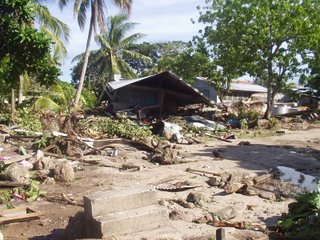
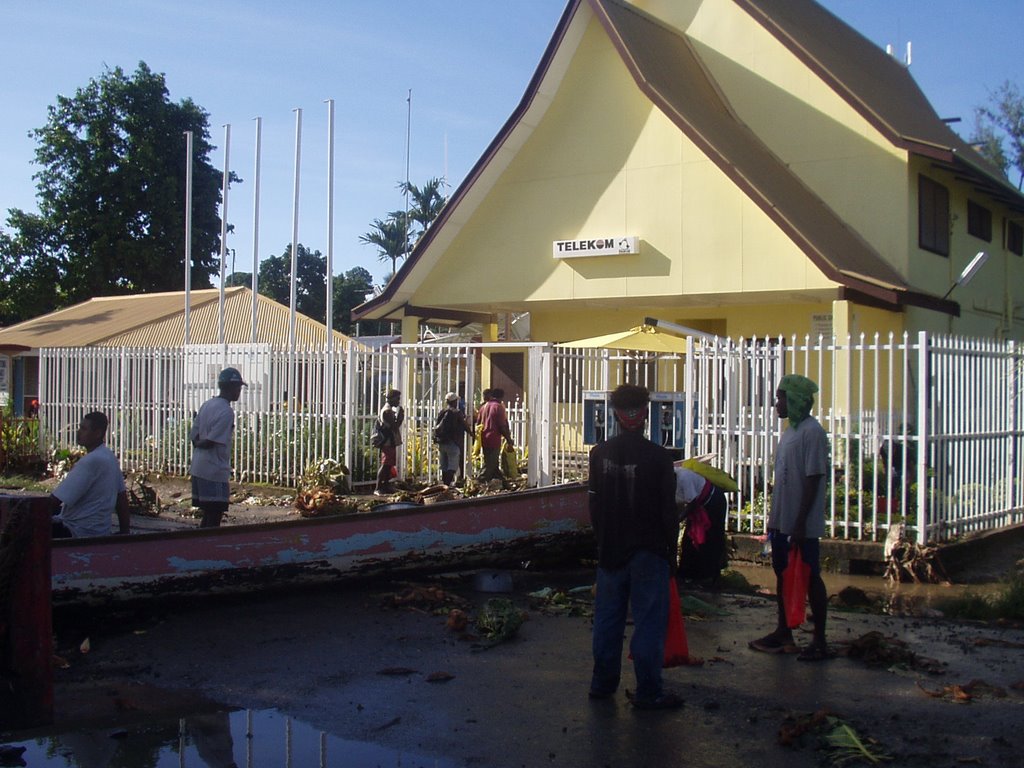
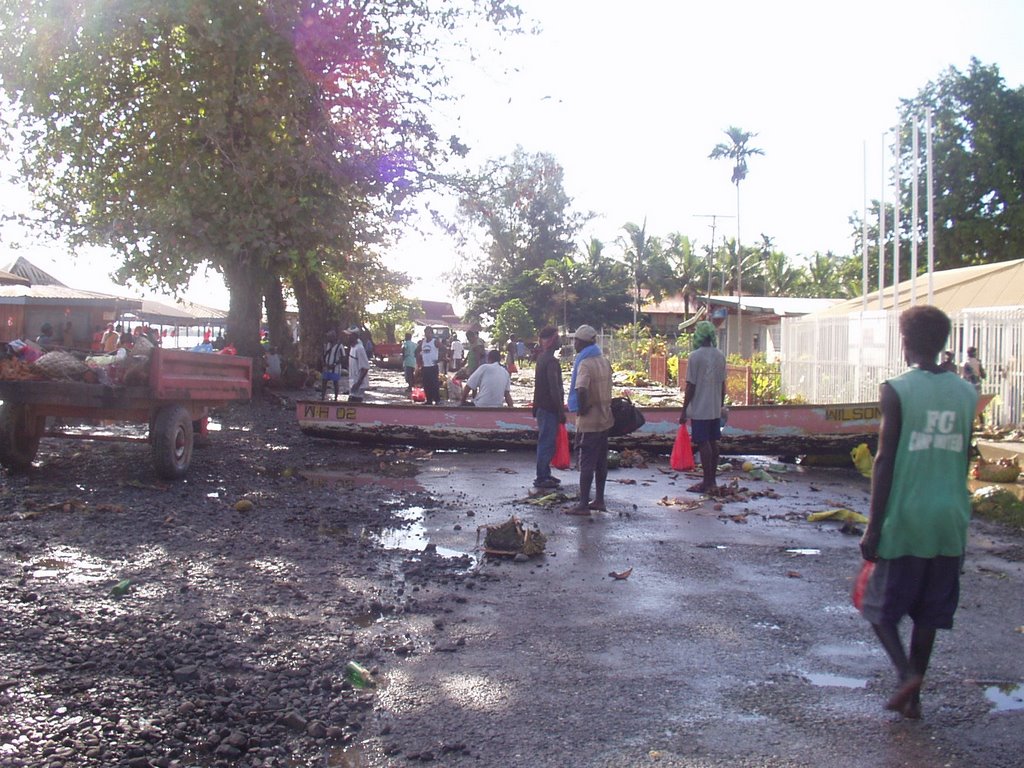
Aftermath of theTsunami in Solomon Islands
These are some of the images of the damages done by the Tsunami and Earth Quake to parts of Gizo in the Western Province of Solomon Islands. Relief Supplies have been coming into the victims assessment is still being done to some affected areas.


Monday, October 16, 2006
Solomons pair spark victory.
By TONY SMITH 
Solomon Islands super-subs Henry Fa'arodo and Batram Suri sparked a first-ever opening day victory for Canterbury United in the national soccer league.Read More
Solomon Islands super-subs Henry Fa'arodo and Batram Suri sparked a first-ever opening day victory for Canterbury United in the national soccer league.Read More
Wednesday, October 11, 2006
SUSPENDED ATTORNEY GENERAL FLOWN INTO HONIARA

Julian Moti [front] escorted by RAMSI police officer, followed by Chris Hapa and Robson Djiokovic after arriving in Honiara airport from Munda in a chopper this afternoon.
SIBC ONLINE:
The suspended attorney general Julian Moti has been flown to Honiara in handcuffs following his arrest at Munda earlier today.
The suspended attorney general Julian Moti has been flown to Honiara in handcuffs following his arrest at Munda earlier today.
Police say Mr Moti touched down at Munda runway on an unscheduled Papua New Guinea defence force aircraft at about five o'clock this morning.
He left the plane with four other men, including an official from the prime ministers office Robson Djoikovic and his lawyer Chris Hapa.
The Police media unit in Honiara says all five men fled when approached by officers from the Solomon Islands Police Force and RAMSI.
Mr Moti and Mr Djoikovic were captured immediately. Mr Hapa gave himself to police later.
Two other men are still being sought, but their identities are unknown.
Solomon Airlines and Aviation Control Towers workers in Honiara were not informed of arrangements for the flight.
Munda Police say Mr Moti did not have a passport with him on arrival.
They say Mr Moti told them that this would be taken care of by Government officials from Honiara.
Mr Moti's Australian passport was cancelled by Canberra at the time of his arrest in Port Moresby.
Australia issued an extradition warrant last month for Mr Moti for alleged child sex offences allegedly committed in Vanuatu in 1997.
Mr Moti arrived at Police Headquarters at Rove this evening.
SIBC reporter Walter Nalangu has details.
Mr Moti and the two Solomon Islanders assisting him arrived at Rove in separate vehicles about half past five this evening. The two Solomon Islanders are the Prime Minister's political analyst Robson Djoikovic and Chris Hapa of Pacific Lawyers. They were escorted in a police convoy from Henderson airport where they arrived from Munda in a police helicopter. The Police Media Unit in Honiara says all men will spend the night in police custody. It says they will be questioned by officers of the Solomon Islands Police Force. The office however could not confirm what charges could be laid against them. It is however understood the men are being investigated for breaching immigration and customs regulations, by entering the country without immigration and customs clearance. Moti's Australian passport is understood to have been cancelled by Australia.
Friday, October 06, 2006
Bond University drops Moti page
A current Google search returns a Bond University link at Number 1 position for Julian Moti - however, it appears Bond University have decided to erase this page as noted by ... Read More
Australia issues second-highest level travel warning for Solomon Islands
The Australian federal government has issued a strong warning for Australians thinking of travelling to the Solomons.
The Department of Foreign Affairs and Trade (DFAT) upgraded its overall level of travel advice for the Solomons, warning Australians to reconsider altogether any scheduled travel to the country.Read More
The Department of Foreign Affairs and Trade (DFAT) upgraded its overall level of travel advice for the Solomons, warning Australians to reconsider altogether any scheduled travel to the country.Read More
Downer expects PNG to allow Moti extradition

Alexander Downer says he expects PNG to allow the extradition of Julian Moti. (File photo) (Insiders)
Foreign Affairs Minister Alexander Downer says he expects the Papua New Guinea (PNG) Government to act according to the rule of law and allow the extradition of the suspended Solomon Islands Attorney-General Julian Moti.
PNG and the leaders of the Solomon Islands have criticised Australia for seeking Mr Moti's arrest to face child sex charges in Australia.
But Mr Downer says the way the Solomon Islands Government has handled the matter raises questions about its governance.
"I think 20 million Australians know there's something wrong with this and I think people around the Pacific know there's something wrong with it," Mr Downer said.
"It just gets to the very heart of what we're concerned about which is governance in the Solomon Islands."
Meanwhile a planned vote of no confidence against Solomon Islands Prime Minister Manasseh Sogavare was deferred amid claims by the opposition that some of its supporters had been threatened.
Mr Downer says he does not want to get involved in Solomon Islands politics and will not comment directly on the alleged threats.
"I think the important thing here is that they pursue their politics in a calm way without threats, without intimidation," he said.
"Try to make the arguments on the merits of the arguments one way or another.
"I mean, there's been talk of the opposition moving a no confidence motion, that's really none of our business."
New Source: ABC NEWS
OPPOSITION LEADER DEFERS MOTION OF NO CONFIDENCE
The Opposition leader Fred Fono has withdrawn the motion of no confidence in the Prime Minister, Manasseh Sogavare.
Mr Fono has asked that the motion be deferred from today's order paper.
"Thank you Mr Speaker, I too beg leave that Standing Order 31(1) be suspended under Standing Order 81 to withdraw the motion I was to move today. The motion of no confidence in the Prime minister to have it moved on the Friday the 13th, October 2006."
Speaking to journalists after parliament was adjourned, Mr Fono said he deferred the motion because of security threats.
He said members from both the opposition and government sides who signed a memorandum of understanding in support of the motion have received threats.
More in our Midday report program after the news.
The government has denied plans to issue a Solomon Islands passport to the suspended Attorney General Julian Moti.
Answering a question from the Opposition leader, Fred Fono on the matter, Prime Minister Manasseh Sogavare says the government has not yet decide on issuing a passport to Mr Moti.
Mr Sogavare questions where the information comes from.
Meanwhile, Commerce, Industries and Employment Minister Peter Shanel says the matter of issuing a passport to Mr Moti has not reached his office.
"The question of issuance of passport to the person concerned has not reached my office. I am not aware of any issuing of passport to the person concern."
The Honiara Town and Country Planning Board has expressed anger and disappointment with the Lands and Housing Minister for revoking its decision.
Board secretary Arlene Lingo says since April, the board has rejected six commercial applications for land designated for public open space.
The Board plans to revoke three similar developments which were previously approved.
The Minister had revoked two decisions by the board to reject commercial development on land designated for public open space, and has indicated he will not revoke earlier approvals.
Former senior public officer says Australia's Prime Minister John Howard and Foreign Minister, Alexander Downer should refrain from criticising Solomon islands political leaders as corrupt.
Mr Karani says Solomon islands political leaders are elected to office by the people of Solomon islands and it is rather absurd for someone outside or in another country to poke their nose into the domestic affairs of this country.
Karani says if the two Australian leaders were genuinely concerned about honesty by leaders, they would do better concentrating their efforts in the case of Australia Wheat Board scandal.
Senior diplomats from Papua New Guinea and Fiji will meet Australian officials today to discuss Canberra's row with Solomon Islands.
The secretary of Papua New Guinea's foreign affairs department, Gabriel Pepson, and Fiji's foreign affairs head, Isikeli Mataitoga, are to have the meeting in the Australian capital.
They have already visited Solomon Islands and the Pacific Forum Secretariat in Suva to discuss the diplomatic crisis, which was sparked in September when the Solomons expelled Australia's top diplomat from Honiara.
Radio Australia reports that Australia's foreign affairs department says it is happy to talk to the diplomats.
However, a department spokesman says Australia has made clear that it sees no need for any mediation by South Pacific countries, and says the delegation has accepted the meeting will not be a form of mediation between Solomon Islands and Australia.
A third newspaper begins circulation in Honiara today.
Island Sun is published under the Trade Wind Company and owned by four local entrepreneurs.
Editor and one of the owners Donaldson Rusa says this is to give readers a variety.
The Island Sun was on sale in shops and streets of Honiara today and will be distributed to some provincial centres soon.
Rusa says the 12-pages newspaper will cover general issues, features, World, Pacific and sports news.
It will be published on Fridays.
News Source: Solomon Islands Broadcasting Corporation
Mr Fono has asked that the motion be deferred from today's order paper.
"Thank you Mr Speaker, I too beg leave that Standing Order 31(1) be suspended under Standing Order 81 to withdraw the motion I was to move today. The motion of no confidence in the Prime minister to have it moved on the Friday the 13th, October 2006."
Speaking to journalists after parliament was adjourned, Mr Fono said he deferred the motion because of security threats.
He said members from both the opposition and government sides who signed a memorandum of understanding in support of the motion have received threats.
More in our Midday report program after the news.
NO PLANS TO ISSUE PASSPORT TO MOTI
The government has denied plans to issue a Solomon Islands passport to the suspended Attorney General Julian Moti.
Answering a question from the Opposition leader, Fred Fono on the matter, Prime Minister Manasseh Sogavare says the government has not yet decide on issuing a passport to Mr Moti.
Mr Sogavare questions where the information comes from.
Meanwhile, Commerce, Industries and Employment Minister Peter Shanel says the matter of issuing a passport to Mr Moti has not reached his office.
"The question of issuance of passport to the person concerned has not reached my office. I am not aware of any issuing of passport to the person concern."
HONIARA PLANNING AUTHORITY EXPRESSES DISAPPOINTMENT
The Honiara Town and Country Planning Board has expressed anger and disappointment with the Lands and Housing Minister for revoking its decision.
Board secretary Arlene Lingo says since April, the board has rejected six commercial applications for land designated for public open space.
The Board plans to revoke three similar developments which were previously approved.
The Minister had revoked two decisions by the board to reject commercial development on land designated for public open space, and has indicated he will not revoke earlier approvals.
FORMER SENIOR GOVERNMENT OFFICER CALLS FOR REFRAIN
Former senior public officer says Australia's Prime Minister John Howard and Foreign Minister, Alexander Downer should refrain from criticising Solomon islands political leaders as corrupt.
Mr Karani says Solomon islands political leaders are elected to office by the people of Solomon islands and it is rather absurd for someone outside or in another country to poke their nose into the domestic affairs of this country.
Karani says if the two Australian leaders were genuinely concerned about honesty by leaders, they would do better concentrating their efforts in the case of Australia Wheat Board scandal.
CANBERRA AND HONIARA ROW DISCUSSED
Senior diplomats from Papua New Guinea and Fiji will meet Australian officials today to discuss Canberra's row with Solomon Islands.
The secretary of Papua New Guinea's foreign affairs department, Gabriel Pepson, and Fiji's foreign affairs head, Isikeli Mataitoga, are to have the meeting in the Australian capital.
They have already visited Solomon Islands and the Pacific Forum Secretariat in Suva to discuss the diplomatic crisis, which was sparked in September when the Solomons expelled Australia's top diplomat from Honiara.
Radio Australia reports that Australia's foreign affairs department says it is happy to talk to the diplomats.
However, a department spokesman says Australia has made clear that it sees no need for any mediation by South Pacific countries, and says the delegation has accepted the meeting will not be a form of mediation between Solomon Islands and Australia.
A NEW NEWSPAPER LAUNCHED IN HONIARA
A third newspaper begins circulation in Honiara today.
Island Sun is published under the Trade Wind Company and owned by four local entrepreneurs.
Editor and one of the owners Donaldson Rusa says this is to give readers a variety.
The Island Sun was on sale in shops and streets of Honiara today and will be distributed to some provincial centres soon.
Rusa says the 12-pages newspaper will cover general issues, features, World, Pacific and sports news.
It will be published on Fridays.
News Source: Solomon Islands Broadcasting Corporation
Sneak Peak :SI Contigent to the Festival
These are some images taken from the welcome function hosted by the USP Solomon Islands Student studying in Suva. The contigent gave a preview of their cultural items and displays which was received with much praise from the students who are proud that this event will turn the tide of time towards the promotion of tourism to our isles.


Contigent from Malaita Outer Islands


Toelegu Panpipers from Isabel Province
Photos courtesy of Matilda Dani
Photos courtesy of Matilda Dani
SIS A ELECTION RESULTS 2006
The Solomon Islands Students studying at the University of the South Pacific on Tuesday 3th october had their General Election for 2006 for the executive post of SISA. The Returning Officer qouted as saying that the Turn up for voting was very good in cmparision to last years election . A total 327 students did turn up on the voting day.
The total registered Voter = 492
Total vote cast 3/10/2006 = 327
Invalid Votes = Nill
President Post
*******************************
Stephen Maesiola = 109
Joyce Maetoloa = 82
Alwyn Danitofea = 71
Peter fairamoa = 42
Stefaldo Fanakui = 23
Vice President
******************
Mary Tavava = 86
Dentana Kosiko = 63
Herman Aruhane =58
Rodney Suibaea =75
Frosty Kohaimane= 45
Secretary Post
******************
Matilda Dani = 134
Frank Panda = 109
Moses Haganitoto= 84
The newly elected President of SISA is Mr.Stephen Maesiola, a Post Graduate student doing good Governance and a long time serving officer in the government of Solomon Islands. The Vice President is Mrs. Mary R. Tavava, Secretary is Miss Matilda Dani and Treasurer is Miss Millisidy Qaqara who stood unoposed after the formal resignition of Micah Alopitu.
The total registered Voter = 492
Total vote cast 3/10/2006 = 327
Invalid Votes = Nill
President Post
*******************************
Stephen Maesiola = 109
Joyce Maetoloa = 82
Alwyn Danitofea = 71
Peter fairamoa = 42
Stefaldo Fanakui = 23
Vice President
******************
Mary Tavava = 86
Dentana Kosiko = 63
Herman Aruhane =58
Rodney Suibaea =75
Frosty Kohaimane= 45
Secretary Post
******************
Matilda Dani = 134
Frank Panda = 109
Moses Haganitoto= 84
The newly elected President of SISA is Mr.Stephen Maesiola, a Post Graduate student doing good Governance and a long time serving officer in the government of Solomon Islands. The Vice President is Mrs. Mary R. Tavava, Secretary is Miss Matilda Dani and Treasurer is Miss Millisidy Qaqara who stood unoposed after the formal resignition of Micah Alopitu.
Tuesday, September 05, 2006
Solomon Bilikiki drawn into Group C
SIFF-Sporting Pulse
HONIARA, 5 Sept 2006: Solomon Islands Beach Soccer team has been drawn into Group C, together with Portugal, Uruguay and an African country for the FIFA Beach Soccer World Cup in Brazil in November.
The draw has pitted Solomon Islands against two of the best soccer playing nations in the World however this will not intimidate the boys from the pacific who will participate in the world stage for the first time.
World cup soccer had produced many upsets in the past and history can repeat itself again in this upcoming competition scheduled to take place at Copacabana beach, Rio de Janeiro-Brazil between 2 and 12 November 2006.
SIFF President Martin Alufurai is confident Solomon Islands can cause upset in the World Competition and will do all he can in his capacity to ensure the team gets a descent preparation before the competition kicks off in November.
He says he had told SIFF General Secretary Eddie Ngava and Small Sided Games development officer Eddie Omokirio before they departed for the futsal/beach soccer seminar at Papeete that a new code is born in Solomon Islands referring to beach soccer and has taken a giant leap in its introductory stage to become the first to compete in FIFA World event.
HONIARA, 5 Sept 2006: Solomon Islands Beach Soccer team has been drawn into Group C, together with Portugal, Uruguay and an African country for the FIFA Beach Soccer World Cup in Brazil in November.
The draw has pitted Solomon Islands against two of the best soccer playing nations in the World however this will not intimidate the boys from the pacific who will participate in the world stage for the first time.
World cup soccer had produced many upsets in the past and history can repeat itself again in this upcoming competition scheduled to take place at Copacabana beach, Rio de Janeiro-Brazil between 2 and 12 November 2006.
SIFF President Martin Alufurai is confident Solomon Islands can cause upset in the World Competition and will do all he can in his capacity to ensure the team gets a descent preparation before the competition kicks off in November.
He says he had told SIFF General Secretary Eddie Ngava and Small Sided Games development officer Eddie Omokirio before they departed for the futsal/beach soccer seminar at Papeete that a new code is born in Solomon Islands referring to beach soccer and has taken a giant leap in its introductory stage to become the first to compete in FIFA World event.
Bilikiki dances to Brazil
By MOFFAT MAMU (Star Sports)
THE Solomon Islands Bilikiki Beach soccer team had created history to become the first Pacific Island country to qualify for a FIFA World Championship in Brazil after it defeated Vanuatu 6-2 in the finals in Tahiti.
This means the beach boys have booked themselves a ticket to represent the Oceania region in Rio later this year.
It might have been a new code of soccer being introduced into the country but the turnover effect of the talent that Solomon Islands possessed was evident at the Tahiti qualifier. Read More
THE Solomon Islands Bilikiki Beach soccer team had created history to become the first Pacific Island country to qualify for a FIFA World Championship in Brazil after it defeated Vanuatu 6-2 in the finals in Tahiti.
This means the beach boys have booked themselves a ticket to represent the Oceania region in Rio later this year.
It might have been a new code of soccer being introduced into the country but the turnover effect of the talent that Solomon Islands possessed was evident at the Tahiti qualifier. Read More
Monday, August 14, 2006
Karembeu Inspires Youth
Karembeu was there to inspire young pacific youths. He is the only Pacific Islander to have lifted the World Cup in 1998.
Solomon Islands was on the highlight the first day into the First Pacific Youth festival held in Tahiti Pape'ete. It was the storyof soccer celebrations in Honiara (SI), a uniting factor indeed.

Karembeu and Karamui head to head in Pape'ete, Tahiti
Solomon Islands was on the highlight the first day into the First Pacific Youth festival held in Tahiti Pape'ete. It was the storyof soccer celebrations in Honiara (SI), a uniting factor indeed.
Karembeu and Karamui head to head in Pape'ete, Tahiti
Friday, July 21, 2006
Rework RAMSI to help build sustainable Solomons urges Oxfam
The newly elected government of the Solomon Islands can act to help dampen simmering public dissatisfaction but RAMSI will need to change its approach and seek more ways to support ordinary people to have their say in shaping the future of the country, says a new report by Oxfam as the third anniversary of the mission's arrival approaches.
"More needs to be done to allow ordinary people to help shape the future of the Solomon Islands and to have a say in how development is to address their needs and to create jobs," said Barry Coates, Executive Director of Oxfam New Zealand.
Bridging the Gap Between State and Society - New directions for the Solomon Islands is published today (20 July) to mark the start of a one-day seminar co-hosted by Oxfam International and Transparency International in Honiara to debate the future of the Solomon Islands. The report found that RAMSI's focus on rebuilding the state and machinery of government was missing meaningful consultation with and the informed support of the people of the Solomon Islands.
"RAMSI had been hailed as a model for state building in post-conflict societies," Coates said. "But a central challenge for RAMSI now is to help build a bridge between state and society."
The Oxfam report calls for resources allocated to strengthen the government to be balanced with an increased emphasis on building better linkages between rural and urban communities and the state, as well as addressing concerns for employment, rural livelihoods and basic services.
In 2005, Oxfam interviewed 776 men, women, youths, police, civil society and government officials in Honiara, Malatia and Central Guadalcanal. It found:
* widespread dissatisfaction that government rhetoric on economic development had yet to be translated into real action on livelihoods and human security
*little understanding of the rebuilding process among the general population
* a perception especially in rural areas where RAMSI has less of a presence that security had not greatly improved
* a pervasive sense of exclusion from government decision making and a lack of linkages and engagement between government and its citizens.
A lack of Pacific Island staff in RAMSI also hinders the mission's impact with Solomon Islanders, according to Oxfam. As at end of May 2006, 94 per cent of civilian advisors in the Solomon Islands came from Australia and New Zealand, with Pacific Island staff largely confined to the role of foot soldiers.
"To help promote long-term peace and stability in the Solomon Islands, RAMSI needs to improve community engagement, address security concerns, focus more on livelihoods, food security and rural development and bolster its ranks with increased representation from the region," concluded Coates.
Download the report Bridging the Gap (PDF 2.4mb)
"More needs to be done to allow ordinary people to help shape the future of the Solomon Islands and to have a say in how development is to address their needs and to create jobs," said Barry Coates, Executive Director of Oxfam New Zealand.
Bridging the Gap Between State and Society - New directions for the Solomon Islands is published today (20 July) to mark the start of a one-day seminar co-hosted by Oxfam International and Transparency International in Honiara to debate the future of the Solomon Islands. The report found that RAMSI's focus on rebuilding the state and machinery of government was missing meaningful consultation with and the informed support of the people of the Solomon Islands.
"RAMSI had been hailed as a model for state building in post-conflict societies," Coates said. "But a central challenge for RAMSI now is to help build a bridge between state and society."
The Oxfam report calls for resources allocated to strengthen the government to be balanced with an increased emphasis on building better linkages between rural and urban communities and the state, as well as addressing concerns for employment, rural livelihoods and basic services.
In 2005, Oxfam interviewed 776 men, women, youths, police, civil society and government officials in Honiara, Malatia and Central Guadalcanal. It found:
* widespread dissatisfaction that government rhetoric on economic development had yet to be translated into real action on livelihoods and human security
*little understanding of the rebuilding process among the general population
* a perception especially in rural areas where RAMSI has less of a presence that security had not greatly improved
* a pervasive sense of exclusion from government decision making and a lack of linkages and engagement between government and its citizens.
A lack of Pacific Island staff in RAMSI also hinders the mission's impact with Solomon Islanders, according to Oxfam. As at end of May 2006, 94 per cent of civilian advisors in the Solomon Islands came from Australia and New Zealand, with Pacific Island staff largely confined to the role of foot soldiers.
"To help promote long-term peace and stability in the Solomon Islands, RAMSI needs to improve community engagement, address security concerns, focus more on livelihoods, food security and rural development and bolster its ranks with increased representation from the region," concluded Coates.
Download the report Bridging the Gap (PDF 2.4mb)
Tuesday, July 18, 2006
Scars and Stars
Willie Bugotu
Pape'ete
Dr Jimmie Rodgers head of SPC today sets the scene for the first Youth Pacific Festival in Pape'ete Tahiti. In his statement today to about one thousand plus youths from 28 different countries; he said that, youth focus should be now on a futuristic approach; that is youths ought to be seen as stars for our future; he cautioned that the Pacific Community will be a place of more challenges once the one quarter of a million addition in population each year doubles in twenty years time; this period will be witnessed by alot of us today.
The Solomon Islands Delegation consist of three males; four females; an a govt official. The Solomon Islands Youth delegation will be heading a workshop on Friday sat in Solomons on the Governance in the region; specific points will be on RAMSI; youths in decision making and the experience of the national general elections and clean election campaign
Pape'ete
Dr Jimmie Rodgers head of SPC today sets the scene for the first Youth Pacific Festival in Pape'ete Tahiti. In his statement today to about one thousand plus youths from 28 different countries; he said that, youth focus should be now on a futuristic approach; that is youths ought to be seen as stars for our future; he cautioned that the Pacific Community will be a place of more challenges once the one quarter of a million addition in population each year doubles in twenty years time; this period will be witnessed by alot of us today.
The Solomon Islands Delegation consist of three males; four females; an a govt official. The Solomon Islands Youth delegation will be heading a workshop on Friday sat in Solomons on the Governance in the region; specific points will be on RAMSI; youths in decision making and the experience of the national general elections and clean election campaign
Wednesday, July 12, 2006
Island Business - Solomon Islands: FIRST --PM WANTS RAMSI TO CONCEDE SOME CONTROL
And first to go: Australian police chief
Samisoni Pareti
Solomon Islands’ police chief, Shane Castle, will be the first to go if the new Solomon Islands Prime Minister Mannaseh Sogavare has his way.
The Fiji and New Zealand educated tax auditor believes the Regional Assistance Mission in the Solomon Islands (RAMSI) shouldn’t have its own police chief as opposed to the commissioner of the Royal Solomon Islands Police (RSIP) Force. READ MORE
Samisoni Pareti
Solomon Islands’ police chief, Shane Castle, will be the first to go if the new Solomon Islands Prime Minister Mannaseh Sogavare has his way.
The Fiji and New Zealand educated tax auditor believes the Regional Assistance Mission in the Solomon Islands (RAMSI) shouldn’t have its own police chief as opposed to the commissioner of the Royal Solomon Islands Police (RSIP) Force. READ MORE
Thursday, June 15, 2006
Dr. John Roughan for Secretary to PM: Bad move!
Phil Tagini
Monash University, Melbourne
Instinct tells us that the move by Honorable Prime Minister to appoint Dr. John Roughan as Secretary to PM is good but despite its appearance, it is a bad move.
By appointing Dr. John Roughan as secretary to PM, the government losses, Dr. John Roughan losses and we all lose. Who says instincts can be trusted?
Philip Tagini is a
PhD Candidate
Minerals Law and Policy
Monash University
Monash University, Melbourne
Instinct tells us that the move by Honorable Prime Minister to appoint Dr. John Roughan as Secretary to PM is good but despite its appearance, it is a bad move.
- The government by appointing Dr. Roughan has effectively removed a very staunch critique of its policies. The part played by Dr. Roughan as ‘keeper of conscience’ cannot be replaced by any other individual. Neither the parliamentary opposition, nor the SIDT has the boldness to speak out on social issues the way Dr. Roughan has done in the last 20 years. The government is doing itself a disfavor.
- Heading an NGO is an entirely different role to heading the Government’s chief ministry – the PM’s office with the myriad of responsibilities, demands by subordinates and the public and required skill sets. Dr. Roughan has experience and wisdom, but would he cope with the demands of public life? Believe it or not, the government would have to retrain Dr. Roughan for the demands of government life.
- Contrary to what many believe, the problems we faced in the last 28 years have little to do with poor leaders but more to do with the poor environment within which leaders operate. In order to have effective leaders, the environment in which they operate must be conducive. Having people the caliber of Dr. Roughan without changing the relevant structures does not promise much hope.
- Dr. Roughan is also putting his credibility and history of independence at stake by taking up a four year contract with the government. Whilst, he may continue to write his columns, it would be hard to imagine how credible his writings on social issues would be when he is on government payroll.
- As a leader in civil society and social commentator, the efficacy of his role cannot be questioned. On the other hand, any such efficacy in implementation of government policy cannot be guaranteed.
By appointing Dr. John Roughan as secretary to PM, the government losses, Dr. John Roughan losses and we all lose. Who says instincts can be trusted?
Philip Tagini is a
PhD Candidate
Minerals Law and Policy
Monash University
Thursday, May 25, 2006
‘RAMSI Tuesday’ Wasn’t To Do With Intelligence Failure
By: Mike Wheatley
Wednesday 24 May 2006
Supyire Proverb: ‘The stranger’s eyes are wide open, but he does not see anything’
On Tuesday, 18 April 2006, the democratically elected Prime Minister of the Solomon Islands was stoned by an angry mob on the steps of Parliament, tear gas was tossed around, a large chunk of the national capital, Honiara, was burnt to the ground, livelihoods were lost and lives seriously threatened.
How can such a thing happen on RAMSI’s watch — with the region’s pocket superpower, Australia, in charge? Where’s the stench of burning reputations to match the stench of burning Chinese stores? READ MORE
Wednesday 24 May 2006
Supyire Proverb: ‘The stranger’s eyes are wide open, but he does not see anything’
On Tuesday, 18 April 2006, the democratically elected Prime Minister of the Solomon Islands was stoned by an angry mob on the steps of Parliament, tear gas was tossed around, a large chunk of the national capital, Honiara, was burnt to the ground, livelihoods were lost and lives seriously threatened.
How can such a thing happen on RAMSI’s watch — with the region’s pocket superpower, Australia, in charge? Where’s the stench of burning reputations to match the stench of burning Chinese stores? READ MORE
Subscribe to:
Posts (Atom)